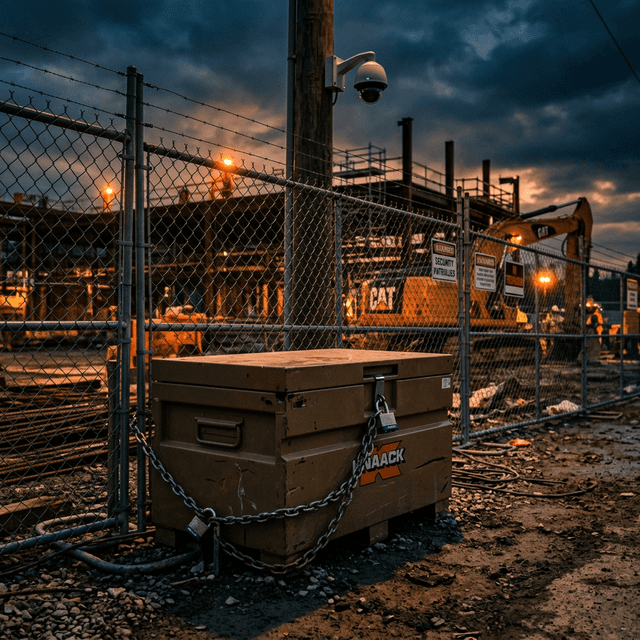
Construction tool theft isn't just annoying — it's expensive. The FBI and the National Equipment Register estimate that $300 million to $1 billion worth of construction tools and equipment are stolen every year in the United States.
And here's the part that stings: most tool theft is internal. It's not some masked burglar cutting your gang box chain at midnight. It's tools "walking off" in someone's truck, getting left at the wrong job site, or quietly disappearing because nobody knows who had them last.
Let's fix that. Here's a complete breakdown of every tool theft prevention strategy that actually works, organized from cheapest to most effective.
Part 1: Physical Security (The Basics)
Gang Boxes and Lockable Storage
The first line of defense. If you're not using lockable job boxes (Knaack, Ridgid, Jobox), you're leaving the front door open.
Best practices:
- Use puck locks instead of padlocks (harder to cut with bolt cutters)
- Chain gang boxes to a fixed structure when possible
- Mark each box with your company name/number in large, visible lettering
- Consider adding a GPS tracker inside high-value boxes ($25–$50 for an AirTag)
Spray Paint and Engraving
The "pink tools" strategy is surprisingly effective:
- Spray all your tools a distinctive, unusual color (hot pink, lime green)
- A thief trying to resell a neon pink Hilti at the pawn shop raises immediate red flags
- Engrave your driver's license number (DL#) on tools — police can use this to identify and return stolen equipment
- Use a UV marker for a hidden secondary mark that's invisible but shows under blacklight
Lighting and Cameras
For open job sites:
- Install motion-activated floodlights around the tool storage area
- Even fake security cameras with blinking LEDs deter opportunistic theft
- For high-value sites, a solar-powered trail camera ($40–$80) gives you footage without needing power
Part 2: Digital Tracking (The Force Multiplier)
Physical security gets you 60% of the way. Digital tracking gets you the rest.
Bluetooth Trackers (AirTags / Tile)
Pros: Location tracking, "lost mode" that notifies you if someone else's phone pings it Cons: Doesn't track who has the tool, costs $25+ each, requires a dense phone network
When to use: Stick one inside your 5–10 most expensive assets (generators, lasers, total stations). Think of it as "insurance insurance" — last-resort location tracking.
QR Code Scan-and-Go Systems
This is where accountability meets simplicity:
- Stick a waterproof QR code on every tool
- Workers scan to check out — system records who, what, when, where
- End of day, you can see: "3 tools haven't been checked back in"
Why this works for theft prevention:
- Creates a paper trail that makes tools "unhealthy" to steal (someone's name is attached)
- Workers who know they're being tracked are far less likely to "borrow" a tool permanently
- When a tool goes missing, you know exactly who had it last
This is the exact problem ScanCrib solves. Our scan-and-go system works on any phone, no app download needed, and runs offline on the job site. See how it works.
Part 3: Policy and Culture (The Long Game)
Technology alone doesn't prevent theft. Culture does.
Implement a Written Tool Policy
Every crew member should sign a tool accountability policy on Day 1:
- Company-owned tools must be checked out/in daily
- Lost or damaged tools must be reported within 24 hours
- Personal tools used on the job should be documented (for insurance)
- Repeated tool loss results in [your company's policy — wage deduction where legal, probation, etc.]
Daily Tool Counts
At minimum, count your high-value tools at the start and end of every day. Sound tedious? With a scan-based system, your foreman can run through 30 tools in about 5 minutes.
Separate Personal and Company Tools
One of the biggest sources of "where did my tool go?" confusion:
- Provide a clear sticker or paint color for company tools
- Encourage workers to mark personal tools differently
- Maintain a list of personal tools each worker brings to the site (protects both parties)
Part 4: Insurance and Documentation
Theft prevention isn't just about stopping theft — it's about being prepared when it happens.
Inland Marine Insurance
This is the policy that covers movable equipment and tools. Every contractor should have it.
What insurers want to see when you file a claim:
- A complete inventory list with serial numbers
- Photos of the stolen items
- Proof of ownership (receipts, purchase records)
- A police report filed within 24–48 hours
- Documentation of security measures you had in place
If you can't produce an inventory list with serial numbers at claim time, your claim will be delayed, reduced, or denied. Period.
Tax Benefits of Tracking
Your CPA will love you if you maintain accurate records:
- Section 179 deduction for equipment purchases
- Depreciation schedules are much easier with digital records
- Casualty loss deductions for stolen equipment (requires documentation)
Prevention Checklist
Before you leave the job site tonight, ask yourself:
- Are all gang boxes locked with puck locks?
- Are high-value tools marked with company colors?
- Do I have serial numbers recorded for my top 20 most expensive tools?
- Is there a sign-out process (even if it's just a clipboard)?
- Do all crew members know the tool accountability policy?
- Would I be able to file an insurance claim tomorrow if I needed to?
If you checked fewer than 4 boxes, you're leaving money on the table (or in someone else's garage).
Start Tracking in 5 Minutes
Download free Excel templates to start documenting your tools today — or jump straight into ScanCrib's QR code system, free for up to 100 tools.
Get Free TemplatesReady to Ditch the Spreadsheet?
Start with our free Excel templates, or jump straight to ScanCrib — free forever for up to 100 tools.
Get Free Templates